What happens when a large number of experts join forces to improve our understanding of the distribution of wild bees in Lower Saxony? Not only are species being reported that have long been considered lost in the state or particularly rare – but evidence is also being found of species that have never before been recorded here! The data, collected over many years in several research projects by experts from across Lower Saxony, was recently published in the journal Artenfocus Niedersachsen. This publication focused on 40 remarkable wild bee species, with detailed accounts of their most recent sightings. Among those involved was Swantje Grabener, a research assistant at the Institute of Ecology at Leuphana University. It is thanks to her that the north-westernmost record of the Lasioglossum aeratum in Lower Saxony has been made. Find out what this record is all about and why this collaboration is so special in this blog post!
All magnifiers on Lower Saxony’s wild bees
Changing environmental conditions are altering the composition of biotic communities and shifting the ranges of species. It is more important than ever to make valid data on distribution and abundance accessible, to share this knowledge, and to inspire people to record and protect biodiversity. At a time when data availability is constantly increasing whilst data quality is declining due to unreliable identification of wild bees by AI-supported tools in global databases, there is a need for reliably validated observations and verifiable evidence of species. To make this possible, many experts from a wide range of fields have joined forces and, through their publication, have expanded our knowledge of the wild bee fauna in Lower Saxony. Among those involved were experts from the Göttingen Society for the Protection of Nature, the Julius Kühn Institute in Braunschweig, the Universities of Göttingen, Hamburg and Lüneburg, the Lower Saxony Elbe Valley Biosphere Reserve Administration, the NLWKN, as well as freelance experts. As you can see, the list of contributors is long, and freelance wild bee expert Rolf Witt also agrees that this is something quite special:
„These findings are of great significance for updating the Red List for Lower Saxony and Bremen, which has now become completely outdated and which we are currently compiling. In the more than 40 years that I have been working on wild bees, this is the first time that such a large group of people has come together to produce a joint publication. This provides the ideal conditions for a high-quality, new Red List.“
Many people – many wild bee sightings
The publication, which is the result of this special collaboration, presents 40 species of wild bees. Seven of these were recorded in Lower Saxony for the first time as part of this project, and many are rediscovers that were last found here before the year 2000. No fewer than 29 of the wild bee species presented have scarcely been recorded to date, and many of them are extremely rare and must be regarded as critically endangered. Thanks to the work of our taxonomists, a total of 395 wild bee species are now known to occur in Lower Saxony.
However, it was not ‘only’ trained wild bee experts who contributed to this valuable insight into rare wild bees. The species records were also compiled as part of students’ final theses, and, for the first time, reports from the major citizen science platforms ‘iNaturalist’ and ‘Observation.org’ were analysed on a large scale. It is precisely this work and these discoveries by volunteer citizens who are passionate about wild bees that make a more valuable contribution to nature conservation than some might think.
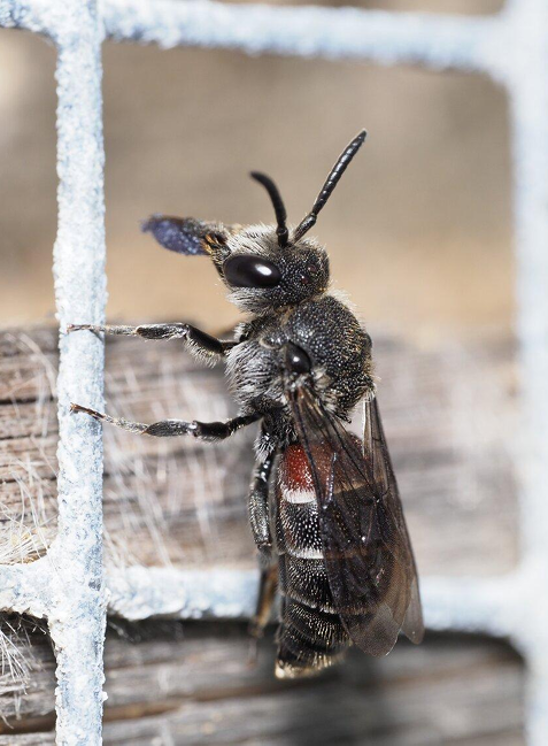
A Dioxys cinctus on a nesting aid for wild bees; this species was recorded for the first time in Lower Saxony near Braunschweig. The first record was reported via the citizen science portal ‘iNaturalist’. (Photo: Dr Jakob Fahr)
The ‘Leuphana discovery‘ of the century
The year is 2017…
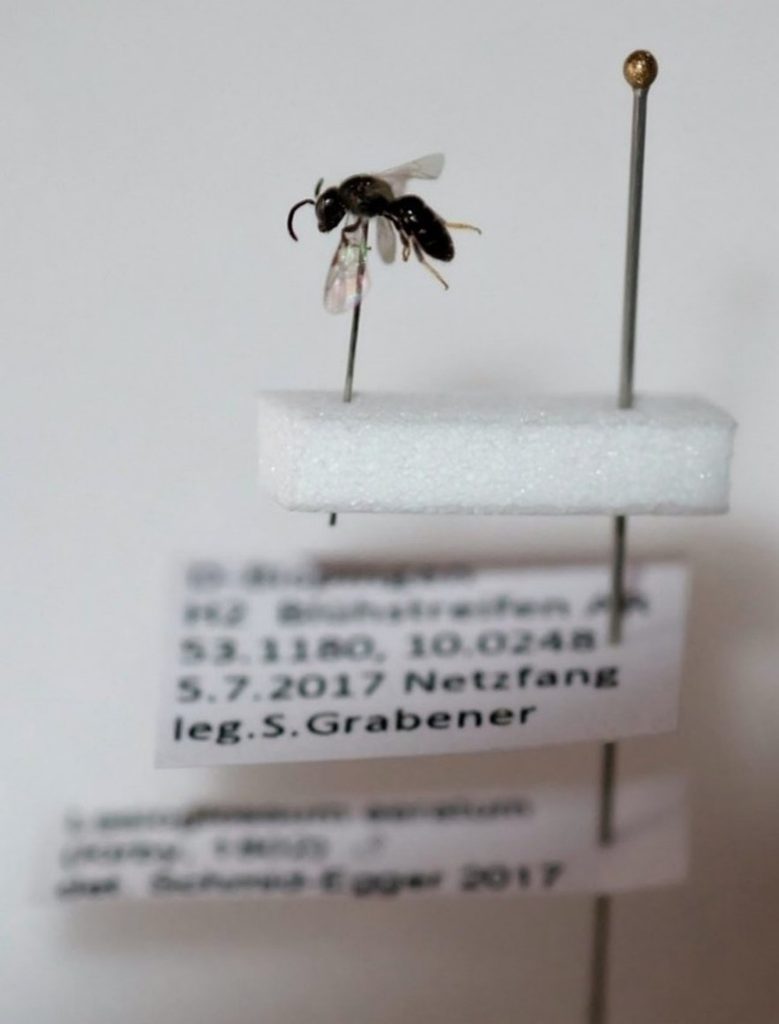
Swantje Grabener is out in the field, in the process of explaining to a student how a small dark spot (she recognises it as a wild bee) on a tansy is caught using a standardised net. Identifying the species turns out to be more difficult than expected. The insect is tiny, and the identification must first be validated by an internationally renowned wild bee taxonomist before it is confirmed: it is Lasioglossum aeratum, a species classified as endangered in Germany and which was considered lost until 2012, as the species had last been recorded in Lower Saxony in 1900. With this discovery in Bispingen, Swantje Grabener also provided the north-westernmost record of the Lasioglossum aeratum in Lower Saxony. This may be a sign that the species’ range has recently been shifting northwards due to rising temperatures caused by climate change. Not only the sand grassland narrow-bodied bee, but also several other particularly thermophilic wild bee species presented in the study are actively shifting or expanding their ranges northwards.
The specimen of Lasioglossum aeratum discovered by Swantje Grabener in 2017. (Photo: Swantje Grabener)
An urgent update to the Red Lists
These and other effects of climate change on wild bees form part of the threat factors whose analysis is of great importance for the compilation of Red Lists of threatened species. The Red Lists of wild bees for Lower Saxony and for Germany as a whole are currently being revised, and this publication makes an important contribution to this process by providing data that is essential for the threat classification of our wild bees. This is particularly important because the taxonomic expertise required to reliably identify species such as the sand-grass narrow-bodied bee is not as widespread as it ought to be. It is no coincidence that there is also a Red List of insect taxonomists, aiming to spread awareness of these important animals throughout the world.
Other important lists…
… are the those of the risk factors facing wild bees and, in turn, the necessary conservation measures. Many of the species featured in the study were recorded in protected areas. This should come as no surprise, as these areas exhibit greater diversity of wild bees compared to unprotected areas. Outside protected areas, however – where habitat loss continues unabated – the reality for our little friends is quite different. The list of causes for this deteriorating situation is long: changes in land use due to intensified farming, habitat fragmentation and isolation, and the degradation of food resources and nesting sites – to name but a few. The list of conservation measures addressing these factors should therefore be just as long as the list of threats, if not considerably longer.
Setting priorities: what it takes to protect endangered wild bee species
Our trusted wild bee experts have a few ideas about what would be needed to boost the protection of wild bees. For instance, Lower Saxony currently lacks government-funded species conservation programmes designed to provide targeted protection for species under acute threat of extinction. Similarly, there is a need for targeted surveys commissioned by the authorities, modelled on the Species and Habitat Conservation Programme in Baden-Württemberg, which is paving the way for the protection of highly endangered wild bees through extensive mapping and measures. Last but not least, wild bee species with the highest threat classifications should be included in the NLWKN’s so-called ‘Priority Lists of Species and Habitat/Biotope Types Requiring Particular Action’. This would ensure that significant funds are made available for their protection in future.
Every discovery counts
Ultimately, it is also the spread of taxonomic knowledge – as facilitated by this collaboration between many different stakeholders – that is enabling us to make great strides forward in our efforts to protect wild bees. Their findings contribute to the revision of the Red Lists, form the basis for conservation measures, and best of all: you too can easily play your part via citizen science platforms (or write your thesis on animal ecology 😉) . So that in the future, the number of recorded wild bee species – in Lower Saxony, Germany and around the world – will grow, and the number of endangered species will decrease thanks to effective conservation measures!
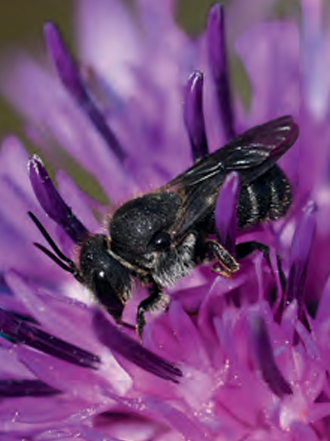
A male Stelis phaeoptera. This species is very rare in Lower Saxony and occurs only in very localised areas. (Photo: J. Wübbenhorst)
If you’d like to find out more about the species featured in the publiction, you’ll find the article in the third issue of the journal: Artenfocus Niedersachsen | Nds. Landesbetrieb für Wasserwirtschaft, Küsten- und Naturschutz
You are fascinated by wild bees and keen to find out more about why they and wasps are so important, what role nesting aids play in their conservation, and how identification guides can help promote a taxonomic perspective? Then do have a look at this other article of this blog: Tracking wild bees and wasps in nesting aids – A guide to identification – Ecologically speaking – Blog on Ecological Research at Leuphana University Lueneburg
If you don’t want to miss any new articles of this blog, then scroll all the way to the end of this site, where you’ll find a subscription tool. Subscribe if you’d like to receive email notifications when there’s a new article posted.