Reconnecting people with nature is a key step forward amid increasing biodiversity loss and climate change. Grassland restoration offers a promising pathway towards achieving this. As Gray et al. said, “Since local people are central to maintaining biodiversity and equally benefit from nature, transdisciplinary and social-ecological approaches to restoration are key to achieving sustainable outcomes.” It’s important that we gain an understanding of how people relate to grasslands and how their individual perceptions shape these relationships. So, what do these relationship-influencing perceptions look like? The authors were keen to find out.
This article was originally posted on the blog of the Social-Ecological Systems Institute of Leuphana by Molly Parker on Gray et al. (2026) Multifaceted landscapes for grassland restoration: exploring individual perceptions on grasslands through photovoice (full citation at the bottom of this post).
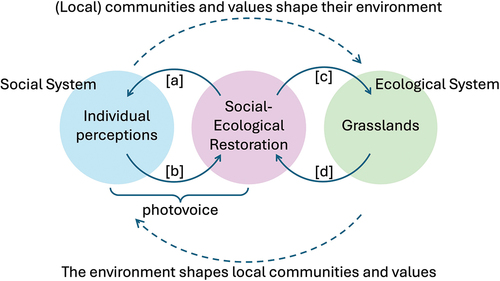
Figure 1. Simplified representation of a social-ecological system (dotted arrows) with social-ecological restoration at the center (inspired by Bennett 2016; Kibler et al. 2018; Grenni et al. 2020). Transdisciplinary social-ecological restoration seeks to establish a beneficial feedback loop (lined arrows): on the one hand, drawing on local values and meanings (e.g. sense of place) [a] to foster care and knowledge co-production, thereby increasing engagement and agency [b]. On the other hand, achieving impacts to improve ecological conditions [c] so that the healthy ecosystem can continue to provide benefits [d]. With the photovoice method the researchers aimed to elicit individual perceptions of local actors, hence the focus in this paper is on the social feedback loop represented as [a] and [b].
This research was conducted in a real-world laboratory for social-ecological grassland restoration in central Germany within the biosphere reserve in the Southern Harz region. Using the photovoice method and concurrent semi-structured walking interviews, the authors set up a social-ecological intervention within the real-world lab by engaging with residents of the village and neighboring citizens. The photovoice exercise aimed not to collect ecological data, but instead to elicit individual perceptions of local actors.
The photos captured meaning and significance in an intelligible and creative form, which the researchers then coded and categorized. Through this, the results showed various perceptions and values of participants of the real-world lab towards grassland and biodiversity in their local landscape. The analysis revealed three narratives relevant to social-ecological grassland restoration:
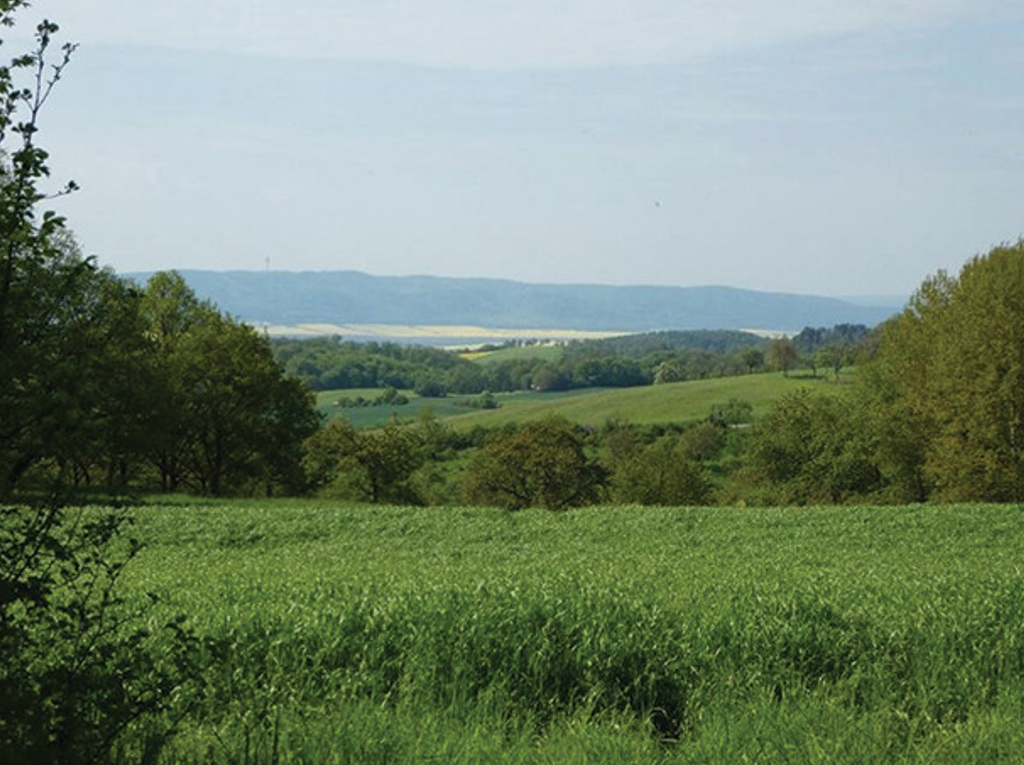
1. Grasslands as meaningful landscape features. Participants valued grasslands as part of a broader cultural landscape mosaic which connects them to local history, identity, and sense of place. The aesthetic beauty of the open landscape was especially important.
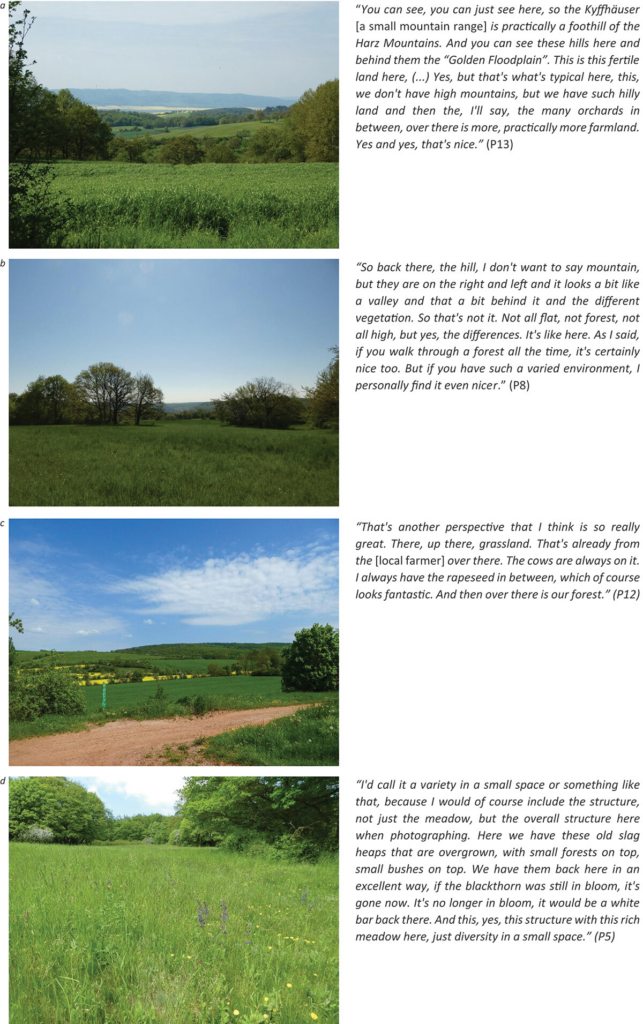
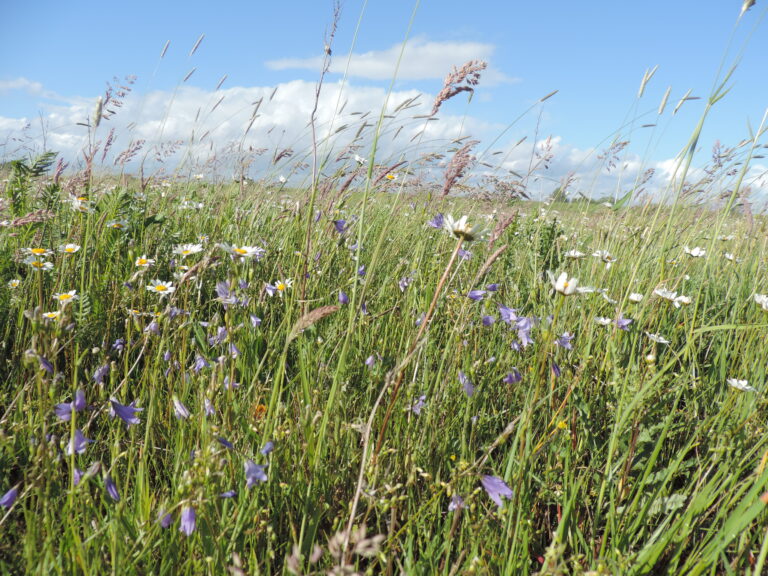
Figure 2. Photovoice examples related to grasslands as meaningful landscape features narrative.
2. Social-ecological processes. Grasslands were perceived in relation to trees and shrubs, with widespread uncertainty about how much human intervention benefits biodiversity. Most recognized that management matters, yet perspectives ranged from stewardship to letting nature take its course. Grasslands provided both instrumental value (fodder, livelihoods) and relational value (recreation, well-being).
3. Unknown life in grasslands. Despite believing biodiversity was “sufficient,” most participants couldn’t assess which species were present or missing. Older residents remembered species that had disappeared, but younger participants lacked this baseline knowledge which outlines a gap that could underestimate the scale of loss.
These narratives provide an understanding of local human-nature relationships, encouraging discussion on how these narratives could cultivate local stewardship and build new pathways for social-ecological restoration. They suggest restoration efforts can succeed by building on existing landscape values and sense of place, fostering dialogue about human-nature relationships, and creating active engagement opportunities that strengthen people’s connection to grassland conservation.
Citation:
Konrad Gray, Anita Kirmer, Miguel Á. Cebrián-Piqueras, Vicky M. Temperton, Joern Fischer & Jacqueline Loos (2026) Multifaceted landscapes for grassland restoration: exploring individual perceptions on grasslands through photovoice, Ecosystems and People, 22:1, 2664493, DOI: 10.1080/26395916.2026.2664493
If you’re interested in the research of the Social-Ecological Systems Institute of Leuphana take a look at their blog. If you don’t want to miss any new articles on this blog right here, then scroll all the way to the bottom of the website to find the subscribtion tool.