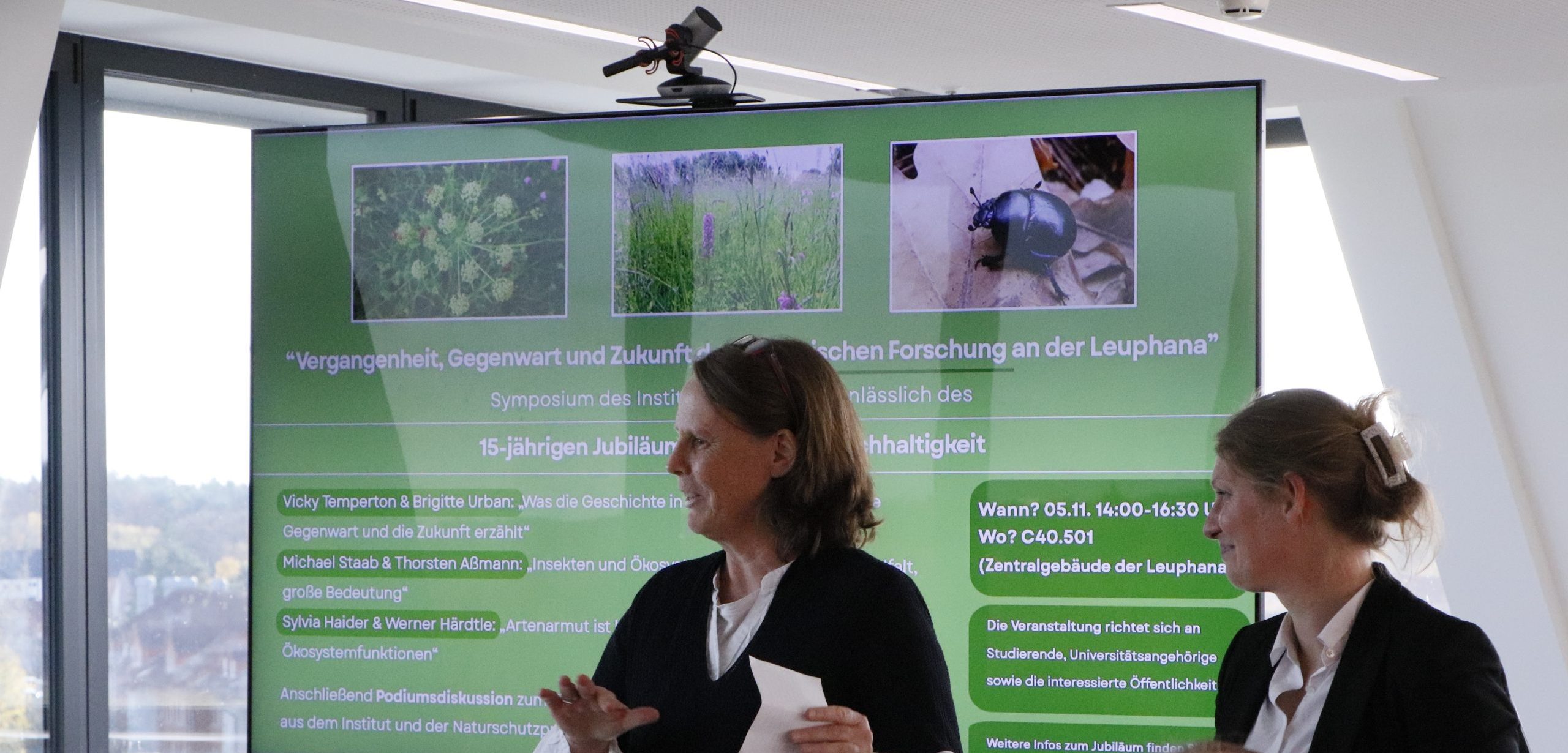
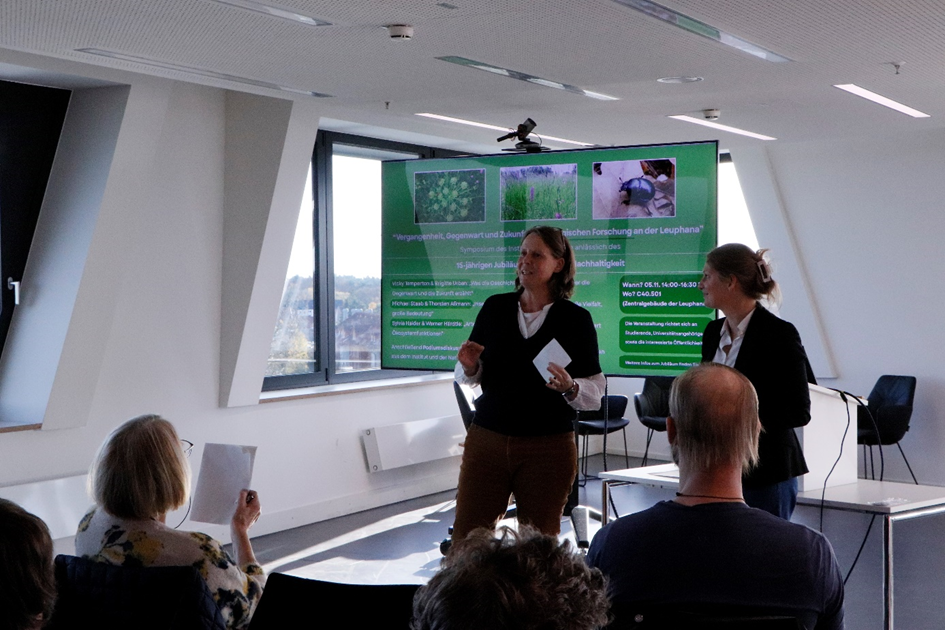
The Faculty of Sustainability at Leuphana University Lüneburg is celebrating its 15th anniversary – making it unique in Germany. To mark this milestone, the individual institutes within the faculty are organizing their own events. The Institute of Ecology also took the opportunity to join in the celebrations. On November 5, members of the institute, practice partners, and a broad audience of people interested in ecology embarked on a journey through the past, present, and future of ecological research at Leuphana. With more than 80 guests and a view of the colourful trees on campus and the autumn afternoon sun, Prof. Dr. Vicky Temperton, head of the institute, and moderator Dr. Agnes Friedel, quality management and study programme consultant in the faculty, opened the event.
A journey through the history of ecology
In the first half, participants were guided through the various research areas by tandem lectures given by the institute’s professors. Former senior professors and long-standing professors appeared alongside the current senior professors in their respective fields. Prof. Dr. Brigitte Urban, Head of the Landscape Change Working Group, and Prof. Dr. Vicky Temperton kicked off the journey through time with a look at what the history of ecology can tell us about the present and the future.
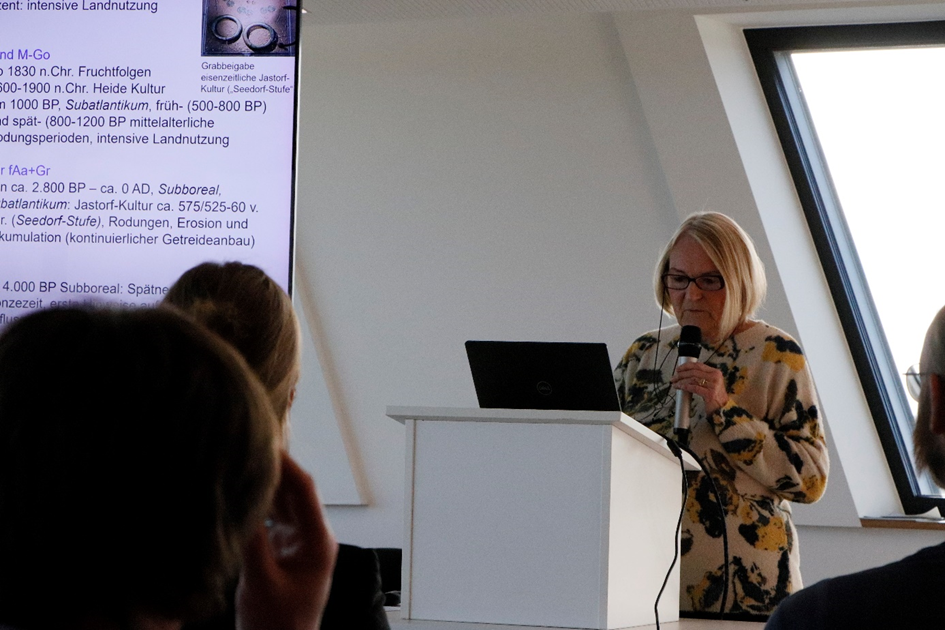
Brigitte Urban presented several research projects on ecological history. In view of the increasing human impact on our environment, it is particularly important to reconstruct former ecosystems in order to understand the current state and enable effective landscape management. While the past teaches us that settlement and human land use can cause long-term problems such as soil erosion in many places, there are also positive examples of natural resilience. The marshlands provide good news in this regard: research on the historical development of upland marshland vegetation reveals that they have a high degree of adaptability to purely climatic changes, even in modern times. However, pressure on upland marshlands is increasing due to human use and climate change, putting this flexibility to the test. If we go even further back in time, to the last interglacial period approximately 125,000 to 115,000 years ago, we encounter very large herbivores, known as megaherbivores. They may have played an important role in shaping the vegetation. What would our landscape look like today if megaherbivores still existed? Brigitte Urban is investigating.
Taking the history of ecology into your own hands
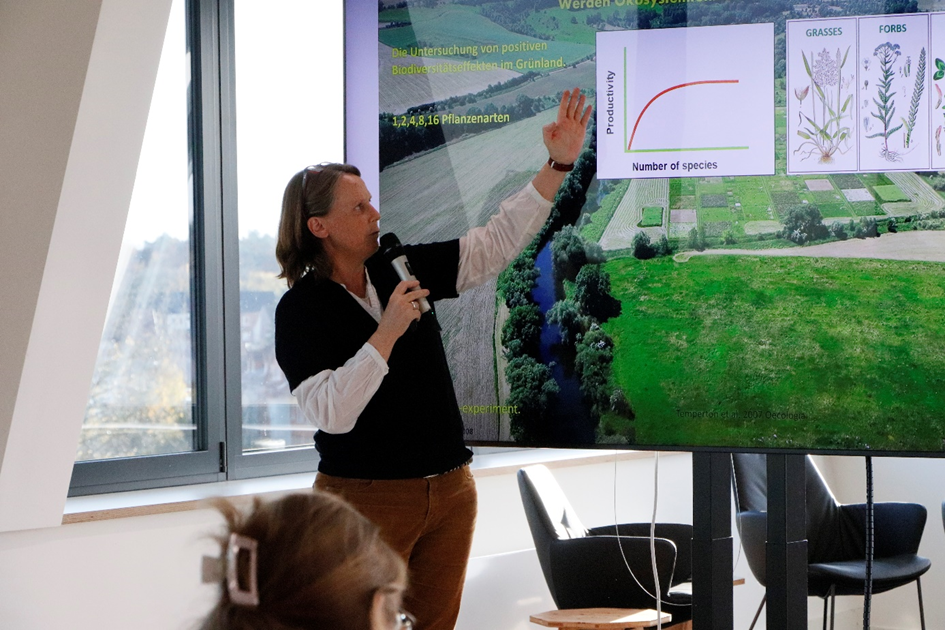
What happens to ecosystems when species are lost? And how does this affect ecosystem functions and services? Vicky Temperton addresses these and other questions in her research. Preserving and restoring biodiversity is not just about species diversity, but also about which plants play a role and what functions and interactions they have. Due to increasing biodiversity loss, it is becoming increasingly important to understand the development of plant communities in order to restore biodiversity. ‘Priority effects’ show that the developmental history of a community, through species that arrived first, influences not only species composition but also ecosystem functions. Vicky Temperton showed the audience that ecologists are not just spectators on a journey through time through the development of plant communities but can and perhaps even should change the history of plants themselves in order to promote biodiversity or certain functions. For instance, positive interactions between certain species groups could be used and the order in which plants arrive in a particular ecosystem could be changed.
Artificial intelligence to the rescue
Looking ahead to future research, each of the tandem presentations included an introduction to new research methods and projects in the respective fields. A glimpse into the future of ecology shows that machine learning with the help of AI can indeed lead to the desired breakthrough in biodiversity experiments. AI is therefore useful both as a measuring tool and for the interdisciplinary integration of ecological knowledge.
A plea for cooperation between science and practice
At the end of the first tandem presentation, the big question arose as to how all this accumulated ecological knowledge can be integrated into society. Have you ever heard of real-world laboratories? In this format, stakeholders from science and practice work together to develop solutions to problems. The focus is on mutual learning in an experimental environment. For Vicky Temperton, real-world laboratories are important in socio-ecological research on the renaturation of degraded ecosystems. ‘When real-world laboratories are scaled up, they offer great potential for transformation,’ says the professor of ecosystem functions and services. And this transformation, with a balance between ecological and social perspectives, is absolutely necessary for the successful renaturation of ecosystems.
‘Insects are incredibly important for everything we do.’
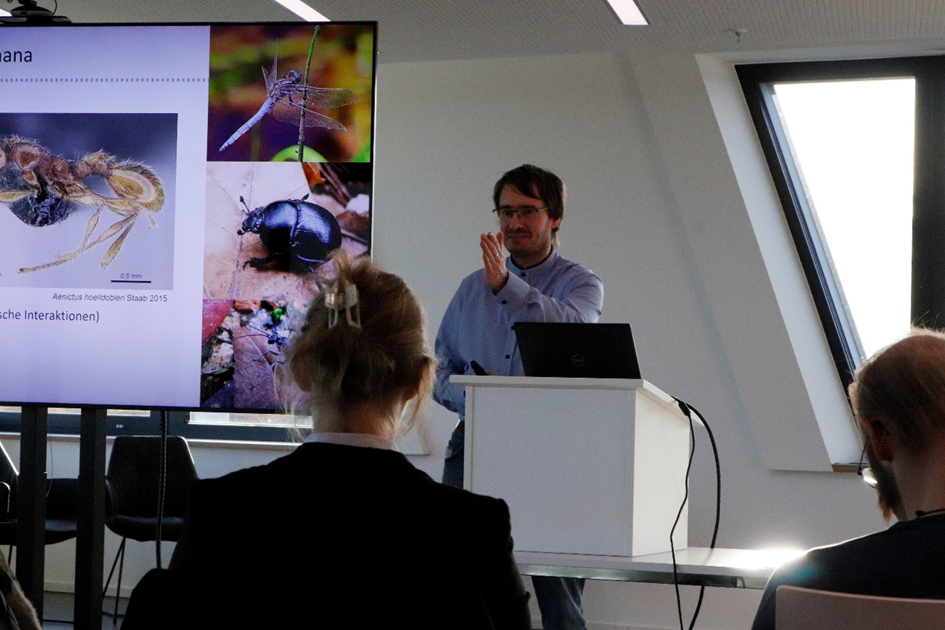
The journey through time continued with Prof. Dr. Michael Staab, who is Head of the Department of Animal Ecology and Trophic Interactions. Representing Prof. Dr. Thorsten Assmann, Professor of Ecology with a focus on animal ecology, who was unable to attend, he provided insights into the great diversity and importance of insects and their ecosystem functions. The past also plays an important role in animal ecology, as Thorsten Assmann’s research on the significance of ice ages for today’s ecological composition shows. The beetle expert is also the only one who has documented the decline of ground beetles through biodiversity monitoring in the Lüneburg Heathland. The rapidly increasing extinction of species is a constant companion in animal ecology research and the basis for many research projects.
Among other things, Michael Staab is investigating how interactions between species give rise to relevant ecosystem functions. How do biodiversity and interactions change when the environment changes? Studies of trees in south-east China show that more species also mean more interactions. A decline in species can therefore have a significant impact on interactions between the remaining species – and not in a positive way. Another focus of Staab’s research is the influence of land use intensity on insect diversity. His research shows that where land use is particularly intensive, the landscape becomes homogeneous and the microclimate in ecosystems also loses its diversity. In a new project, drone imagery will be used to investigate how microclimatic conditions change as a result of different forms of land use, causing insects to lose their habitats. One consequence of insect loss: if insect diversity declines, the ecological balance is disrupted. To prevent this, less intensive use is required – for example, through extensive grazing and staggered mowing.
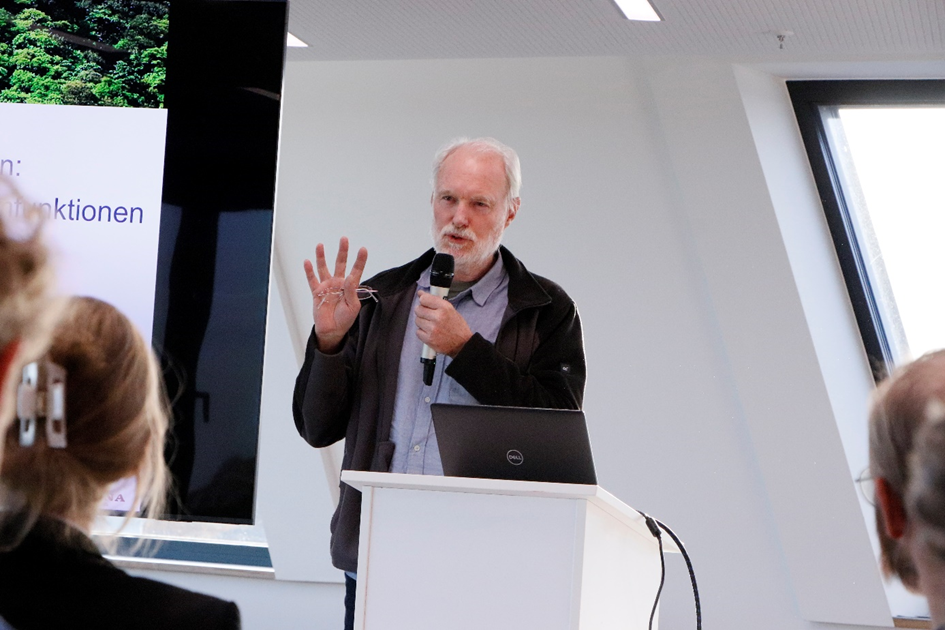
‘Species extinction is the loss of our Earth’s natural historical memory.’
‘Can we afford this?’ asked Prof. Dr. Werner Härdtle, Professor of Landscape Ecology and Nature Conservation. He completed the lecture tour together with Prof. Dr. Sylvia Haider, Head of the Vegetation Ecology and Biodiversity Research Working Group. The clear message from both of them was that species loss is not an option – plant diversity ensures ecosystem functions. Using impressive images, Werner Härdtle compared the burning of tropical rainforests with the fire at the Anna Amalia Library in Weimar 20 years ago, in which thousands of globally unique books were destroyed. This comparison illustrated the enormous loss of species caused by the destruction of the rainforests. Härdtle reported on decades of research in the subtropics of China, where 400,000 trees were planted to experimentally investigate the influence of species diversity. With shining eyes and infectious enthusiasm, the professor presented the results: A rich diversity of tree species can increase the productivity of forests by up to 100%. These effects also help when trees are under stress, for example due to climate change. Species that are sensitive to drought are better supported by biodiversity. However, such biodiversity effects take time, and we should give nature that time.
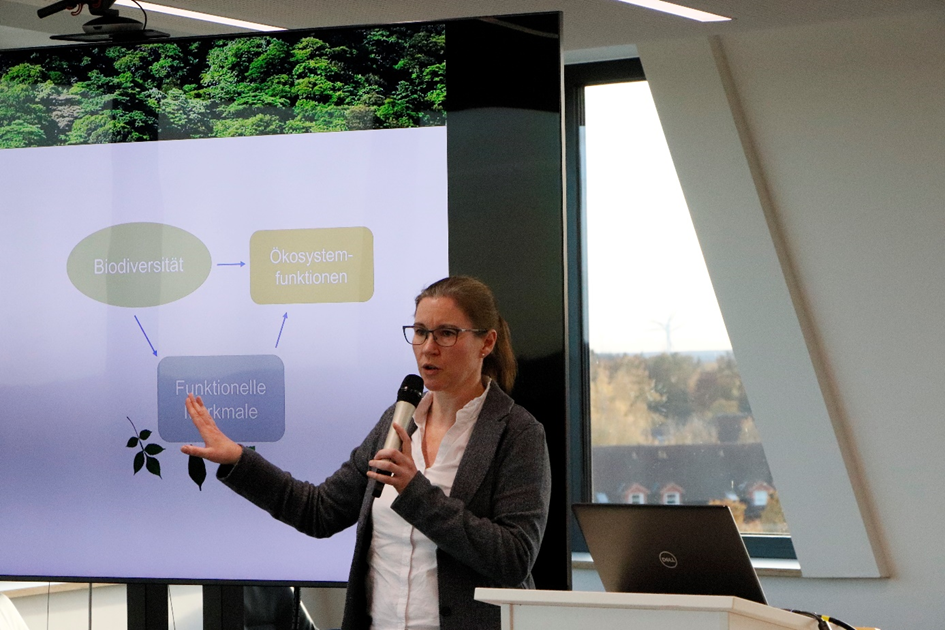
Sylvia Haider focused on the present and future of biodiversity research. She emphasised the role of functional biodiversity, i.e. the diversity of different functional characteristics. This type of biodiversity research also takes into account changing environmental conditions due to climate change, human-induced disturbances and the introduction of invasive species, and their influence on functional characteristics. Haider and her colleagues are part of a globally unique working group that measures the functional characteristics of trees between species, within species and also within individuals. The result: high functional diversity is associated with a high diversity of ecosystem functions. Surprisingly, a substantial proportion of the variability comes from the individuality of the trees.
New habitats at altitude
Finally, let us turn our attention to another level, namely mountains and the research into plant diversity along altitude gradients. How are ecosystems in vulnerable mountain regions changing, and what influence do non-native, introduced species have on this? During the question-and-answer session, the topic of species migration to higher altitudes as a result of climate change was raised. On the one hand, this creates new habitats, which can lead to the protection of species, according to Haider. On the other hand, existing interactions are also disrupted and species that were previously specialised in the mountains are being displaced by migrating species. Research is now needed to determine how this shift will affect biodiversity at altitude in the future.
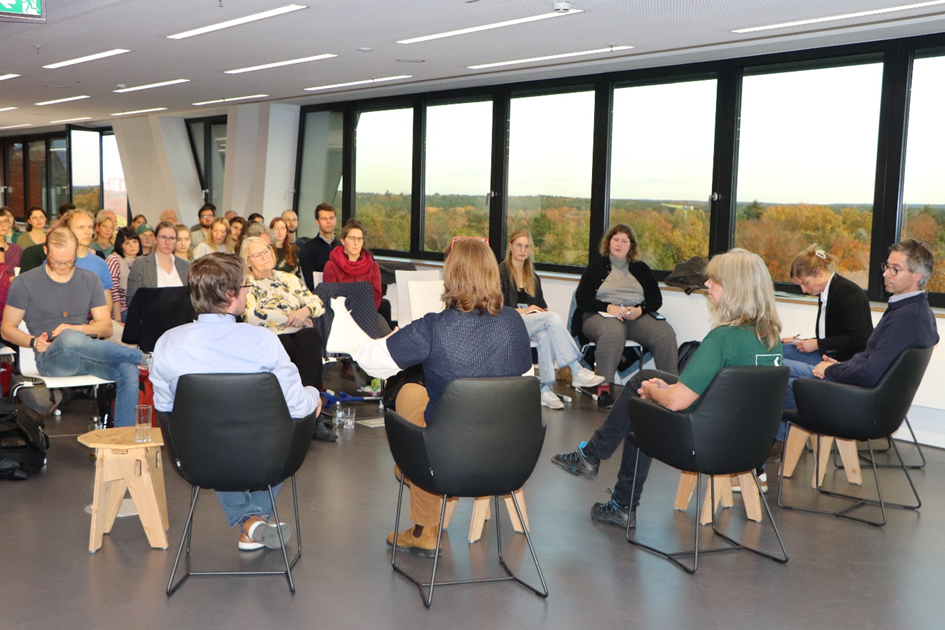
‘Quo vadis ecology?’ – A panel discussion with a view to practical applications and the future
With the setting sun on the guests’ faces and questions about the future of ecological research in their minds, the panel discussion continued after a short break for refreshments. The panel consisted of Prof. Dr. Andreas Fichtner, Professor of Vegetation Ecology and Biodiversity Research, Dr. Heike Brenken, landscape planner at the Lüneburg Heath Nature Reserve Association, Prof. Dr. Vicky Temperton and Prof. Dr. Michael Staab. The first half of the discussion focused on the big question of how to put scientific findings into practice and successfully transform society towards sustainability.
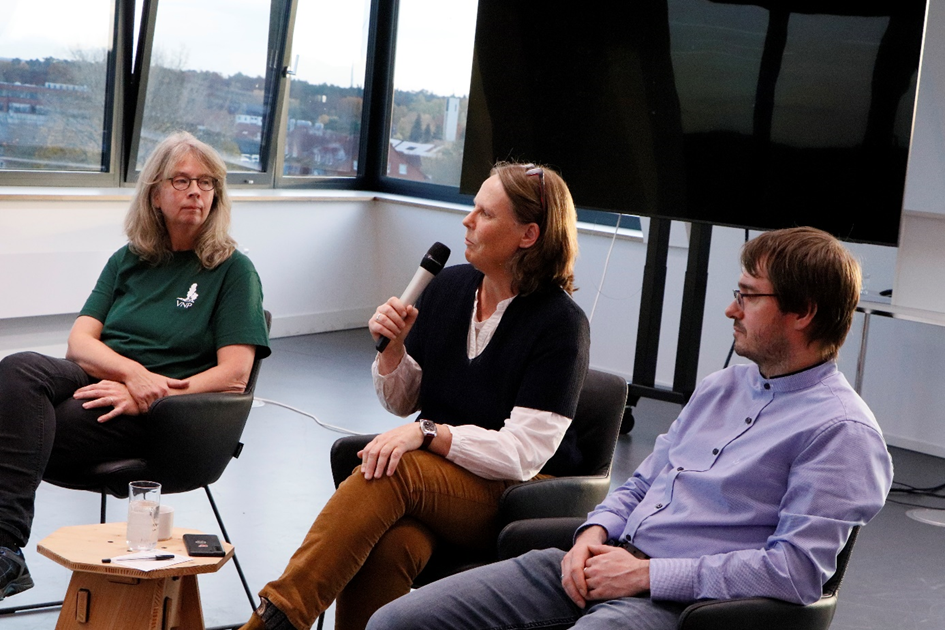
‘We simply cannot continue like this; there are not three Earths!’
– emphasised Vicky Temperton. How can the results of real-world laboratories be widely implemented and practical partners be involved in the process? According to Temperton, it is not only the results that are important for scaling up such projects, but also the process itself. Cooperation between different actors builds trust, without which transformation is not possible. Heike Brenken speaks from her practical experience when she says that basic scientific research is important, but that help is also needed to implement the results on the ground. This is where administration and politics come into play. An article in the local newspaper or a presentation at a farm festival can also be important in increasing citizens’ understanding of nature conservation. In response to the appeal to the administration, a voice from the audience representing the Lower Nature Conservation Authority in Lüneburg spoke up. The participant assured the audience that the administration was also making efforts, but that they often encounter many restrictions. The “adjusting screw” therefore also lies with the people who can change the regulations for nature and species conservation. The students who are being trained at the university as ‘change agents’ could be a glimmer of hope, as they will later form the interface between practice and science with a broad thematic overview.
In the final stages of the journey through time, moderator Agnes Friedel concluded by drawing attention to the pressing ecological issues of the next 15 years against the backdrop of global change. Andreas Fichtner spoke of three important pillars for the future: ecosystem stability, adaptation to global change and a more respectful approach to our environment. However, the core message of research is often not understood in its implementation. Our values play a special role here. What do we find important? What motivates us? The understanding and awareness of the effects of global change on ecosystems, which ecologists experience in their research, must spread throughout society.
But what are the specific steps that can be taken to protect biodiversity?
– asked one participant, and perhaps some readers of this article as well. There is much that can and should be done to preserve biodiversity. Here are a few suggestions from the panel and the audience:
- Spreading awareness in society and politics that we cannot live without nature
- Changing land use, for example by consuming less meat
- Reward ecological services in the economy
- Making sectors such as agriculture and forestry more environmentally oriented and less production-oriented
- Generating motivation for environmental protection at an early age in school
Politicians bear much of the responsibility for this, but grassroots movements within society also have a role to play. The panel and the audience agreed: people must be passionate about protecting biodiversity!
Our journey through different eras and areas of research has shown that communication plays a central role in the protection of biodiversity and ecosystems – because only if we continue to exchange ideas and work together can we achieve this goal. With these closing words, Agnes Friedel bid farewell to the symposium participants as they headed into the evening. And with this thought, this article also bids farewell to its readers as they continue on their journey into a future that could not be more significant for the development of ecology.
Photos: ©Jennifer Fandrich / Leuphana
If you don’t want to miss any new articles of this blog, then scroll all the way to the end of this site, where you fill a subscribtion tool. Subscribe if you’d like to receive email notifications when there’s a new article posted.