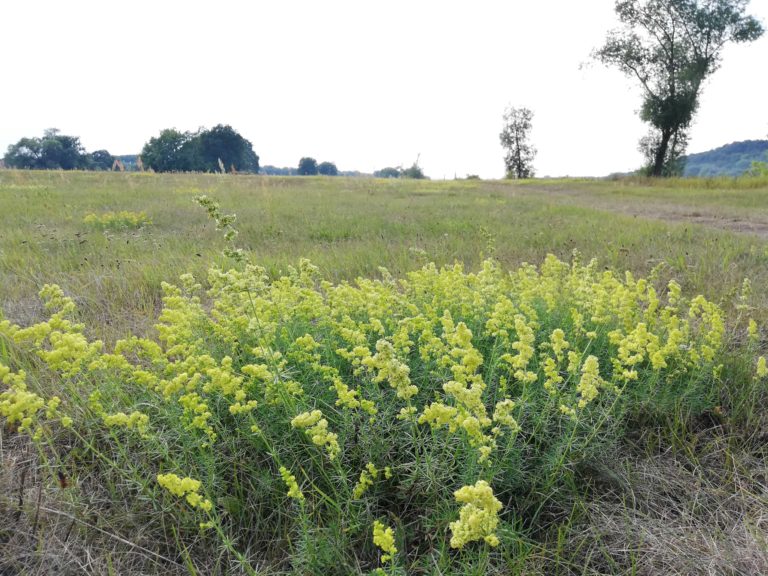
It won’t surprise you that habitat loss and ecosystem degradation caused by intensive land use pose a global threat to biodiversity. For example, intensive land use is one driver behind the widespread decline of insects and other invertebrates. Let’s zoom in on grasslands. While they support a rich diversity of plants and animals, including invertebrates, they are especially vulnerable to intensified land use.
A recently published study by Michael Staab, Professor of Animal Ecology and Trophic Interactions at the Institute of Ecology at Leuphana University, and colleagues investigated if restoring grasslands by reducing land use can support insect abundance and diversity.
Exploring biodiversity experiments: The design of the study
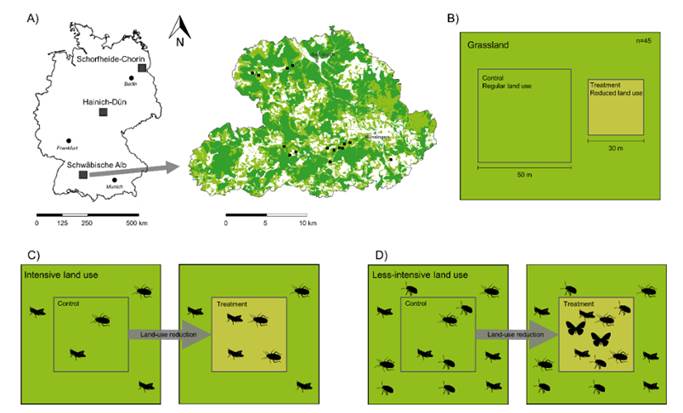
Staab et al. investigated the effect of land-use intensity on invertebrates using a newly established extensification experiment that is part of the Biodiversity Exploratories. This framework was used for understanding how the effects of reduced land use depend on local contexts as well as specific management decisions, which are all part of land use.
How did they find out what’s really the case? The study was conducted at 45 grassland sites across three different regions in Germany. At each site, the researchers compared a regularly managed control plot with a nearby treatment plot with experimentally reduced land use, meaning only a single late mowing per year and no fertilization or grazing. In 2021 and 2023, one and three years after the experiment began, invertebrates were collected on both plots. In 2021, the samples were identified using DNA metabarcoding, allowing a thorough species identification. The team then analysed differences in abundance, diversity and species composition, and tested how factors such as mowing frequency, fertilization and mowing technique in the surrounding matrix as well as management decisions on the reduction plot influenced the magnitude of land-use reduction effects. Keep in mind for the results that there was no diversity data for the second sampling in 2023.

The results: Giving grasslands a break is a win for insect numbers
Reducing land use to one late mowing increased the abundance, so the number of individuals of invertebrates by 41 %. But wait, it gets better: After three years, the abundances in the reduced land-use plots were a full 99 % higher. However, the species richness, Shannon diversity and Simpson diversity between the treatment and the control plots were almost identical after one year. Consequently, the treatment effect of reduced land use had a positive, over time increasing effect on abundance of the invertebrates, but not on their diversity.
Info: Species richness, Shannon diversity & Simpson diversity:
Species richness simply means the number of species in a plot, while Shannon diversity considers both the number of species and how evenly individuals are distributed among them. It increases when many species occur in similar abundances. Simpson diversity also includes richness and evenness but gives more weight to common species. It reflects how dominant the most abundant species are.
But that’s not the whole story. In both years, the magnitude of the treatment effects on abundance depended on the type of land use of the surrounding grassland and on how the plot with reduced land use had been mown in the previous year. The effects of land-use reduction were smaller when the surrounding area had previously been mown more frequently. In contrast, on more fertilized sites, the positive effect of extensification increased. The effect was also larger when the reduced land-use plot was mown with a greater cutting height and when the treatment and control plot were not mown on the same day.
We need to discuss some things:
Why an increase in abundance, but not in diversity?
Reducing land-use intensity quickly boosts invertebrate abundance, which, according to the authors, can be interpreted as a positive reaction of already locally existing species whose populations are benefiting from the reduced disturbance. As you can easily imagine, less frequent mowing kills fewer insect individuals. The species diversity, on the other hand, didn’t change after one year, which suggests that biodiversity recovery takes longer. Additionally, the species composition remained unchanged one year after the start of the extensification, which indicates a strong legacy of past intensive land use. Due to the lack of diversity data for the 2023 sampling, we don’t know if three years after the implementation of reduced land use, the diversity would have increased, or the species composition would have changed. That is for follow-up studies to find out.
Local land-use contexts and management details matter
The positive effects on abundance were smaller in frequently mown landscapes, likely because of the depletion of surrounding populations. Therefore, reducing land use in frequently mown grasslands may be less efficient, unless the area is connected to other unmown or larger habitats. The stronger effects observed in highly fertilized grasslands were likely due to productivity initially remaining high after the fertilization stopped, providing more plant resources for the invertebrates. Findings showing that cutting the grassland at a greater height and not mowing the entire area on the same day is less detrimental to insects demonstrate that insects require refuge areas. Therefore, if we want to promote insects in grassland restoration, we need to use spatially and temporally different mowing rhythms.
What are the take-home messages for conservation efforts?
The study highlights the need for long-term, sustained extensification for successful grassland restoration, whereby its effectiveness for invertebrate conservation varies across local contexts. Clearly, restoring grasslands can play a key role in counteracting insect declines, while a higher invertebrate abundance also supports insect-eating birds and key ecosystem functions. Nevertheless, restoration efforts must balance different biodiversity goals: While an intermediate mowing frequency can increase plant diversity, it can be detrimental for invertebrates. Maximizing restoration outcomes for both plants and insects therefore requires a landscape approach with different measures which also increase heterogeneity and habitat connectivity.
You want to learn more about the study and its findings? Then read the full article here: https://www.sciencedirect.com/science/article/pii/S1439179125000738?via%3Dihub
If you don’t want to miss any new articles of this blog, then scroll all the way to the end of this site, where you fill a subscribtion tool. Subscribe if you’d like to receive email notifications when there’s a new article posted.